Best Presents for 10 Year Old Boys: Engaging STEM Toys and Hands-on Fun
Finding the right gifts for 10-year-old boys means balancing curiosity, learning, and action-packed play. The following selections combine science, technology, engineering, and creative crafting to fuel imagination while building practical skills. Each item is designed to appeal to curious minds with hands-on projects, problem solving, and interactive play that stands up to active, outdoor, and indoor adventures.
Summary of chosen products
| Product | Brand | Key Focus | Amazon Link |
|---|---|---|---|
| Klutz Lego Gear Bots | Klutz | Kinetic engineering with LEGO Technic | No link here in text; see product section |
| National Geographic Magic Chemistry Set | Blue Marble | Magic tricks combined with science experiments | No link here in text; see product section |
| ThinkFun Gravity Maze | ThinkFun | Logic, problem solving, marble maze | No link here in text; see product section |
| Mega Cyborg Hand | Thames & Kosmos | Hydraulic pneumatic mechanics, wearable hand | No link here in text; see product section |
| SCRIB3D P1 3D Pen | SCRIB3D | 3D drawing and spatial thinking | No link here in text; see product section |
Klutz Lego Gear Bots Science/STEM Kit

The Klutz Lego Gear Bots kit lets kids build eight physics-driven kinetic creatures using LEGO Technic bricks and papercraft. Included are all LEGO elements needed and a 64-page book that covers axles, cams, cranks, and everyday engineering concepts with step-by-step instructions. This kit blends hands-on building with foundational STEM learning, encouraging experimentation and iterative thinking as young builders explore motion, gears, and mechanical design.
National Geographic Magic Chemistry Set
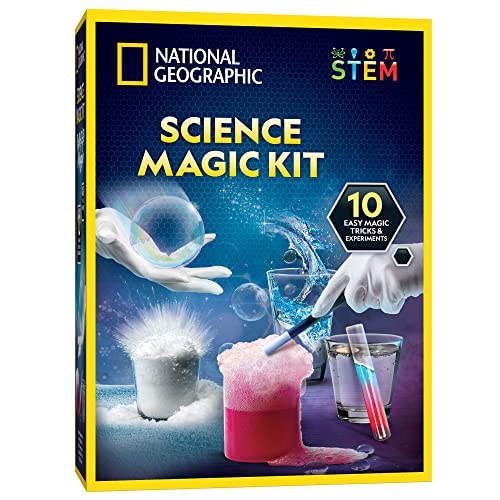
National Geographic’s Magic Chemistry Set combines engaging science experiments with magical props to captivate young learners. Ten experiments include tricks like making coins float and water change color, designed as magic tricks with an included wand and gloves to enhance the theatrical aspect. The illustrated guide offers kid-friendly instructions along with explanations of the science behind the tricks, fostering curiosity and scientific thinking while preserving the wonder of discovery.
ThinkFun Gravity Maze – Marble Logic Game

ThinkFun Gravity Maze invites kids to solve engineering-inspired marble mazes using critical thinking and spatial planning. It features nine towers, three marbles, a game grid, and a target piece, offering endless design possibilities as players navigate gravity-based challenges. The game blends puzzle-solving with hands-on construction, supporting classroom-style problem solving and independent play, suitable for stimulating logical reasoning in a school or home setting.
Mega Cyborg Hand STEM Kit

The Thames & Kosmos Mega Cyborg Hand is a wearable hydraulic hand project. It operates without motors or batteries, relying on air pressure and hydraulic pistons to move its fingers. The kit enables adjustable joints for precise movement and demonstrates pneumatic principles in a tangible, interactive way. This hands-on experience helps learners understand how leverage, hydraulics, and control systems translate into real-world mechanisms.
SCRIB3D P1 3D Printing Pen

The SCRIB3D P1 3D Printing Pen supports creative projects and spatial thinking. It includes three starter colors of PLA filament, a stencil book, project guide, and a charger. The pen offers a stepless speed function for precise control, making it suitable for beginners and more advanced users alike. This tool enables kids to sketch in three dimensions, turning ideas into tangible models and decorations while fostering design thinking.
Buying Guide
Key purchase considerations for gifts aimed at 10-year-old boys include:
- Educational focus: Choose kits that teach core concepts such as physics, engineering, chemistry, and design thinking.
- Skill progression: Look for products that scale with ability, offering more challenging activities as skills grow.
- Hands-on engagement: Prefer kits that require assembly, problem solving, and experimentation rather than passive play.
- Safety and age-appropriateness: Ensure materials are durable and appropriate for the child’s age and safety needs.
- Creative potential: Include tools that enable ongoing exploration, such as 3D drawing or modular building.
- Reusability and storage: Consider products with reusable components and organized packaging for tidy storage after play sessions.
- Social learning aspects: Some kits support cooperative play or classroom-style challenges, beneficial for group settings.
Comparison perspectives:
- STEM depth: Chemistry sets and hydraulics provide concrete science examples, while logic puzzles and modular builders emphasize problem solving and engineering thinking.
- Creativity vs. structure: Combines kits with guided experiments (structured) and open-ended tools like 3D pens (creative expansion).
- Time investment: Some kits yield quick, satisfying results (magical mini-experiments), while others require longer assembly and exploration (robotic or hydraulic projects).